When talking about immersion in video games, realistic graphics, spatial sound, controller vibrations, and increasingly expensive monitors are usually mentioned. The German startup Zestum believes that there is one more sense missing from all of this: smell.
Their first device is called Scentbar, and it is designed as a modular system that releases scents related to what is happening on the screen during gameplay. Zestum was founded in Neuss, Germany, while the project development began in 2023 through a startup program at the University of Applied Sciences in Cologne. The project is backed by a small team of students and engineers who developed the first functional prototype with the support of several university and public innovation promotion programs.
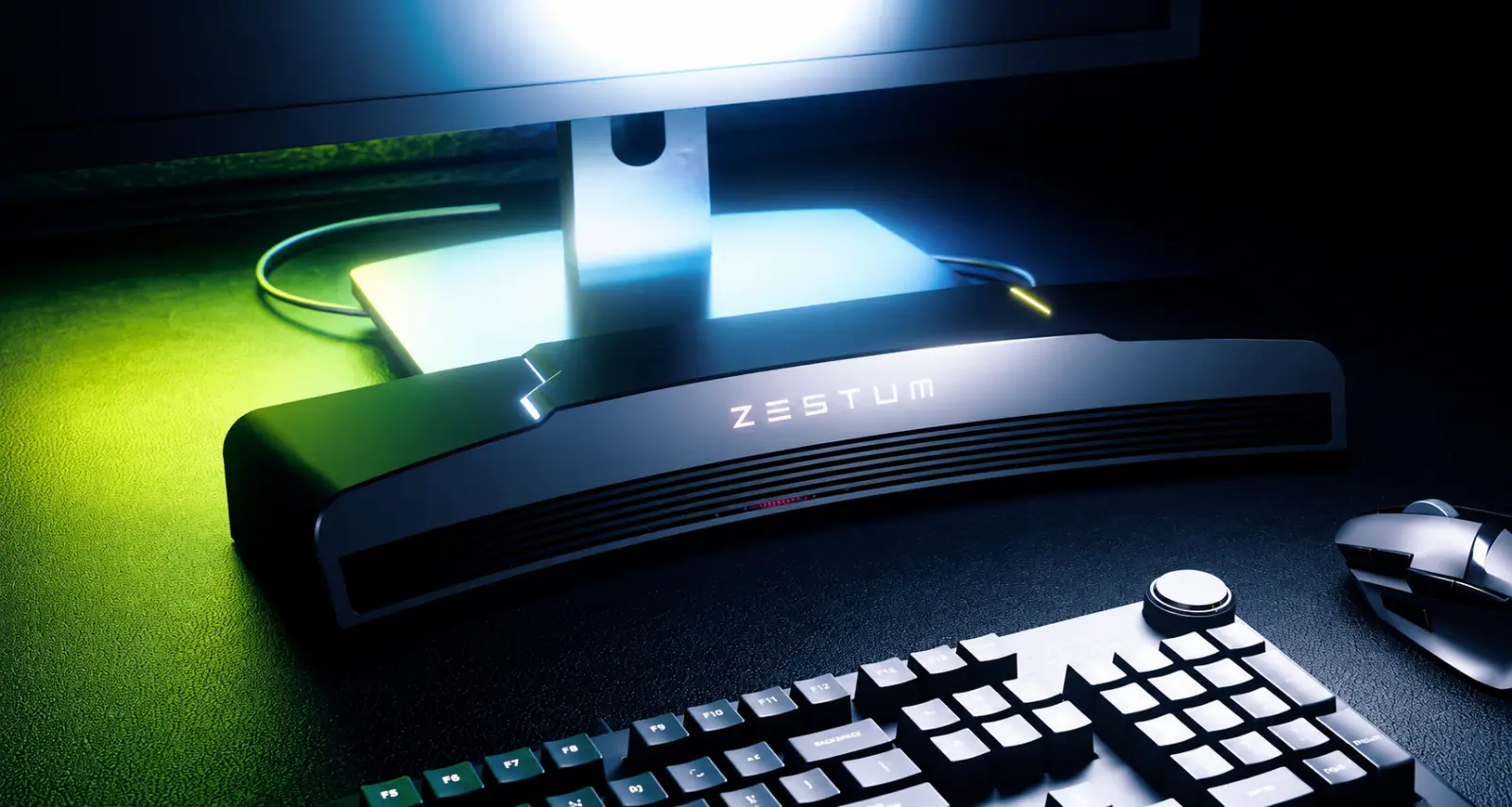
Scentbar resembles a smaller soundbar, but inside the device, there are ten separate slots for scent modules. Each module has its own fan, allowing individual scents to be activated quickly and efficiently. The scent cartridges use pellets based on perfumes, oils, and other additives, and they can be replaced and refilled.
The software analyzes the content displayed on the screen and recognizes certain objects, environments, or events. When it recognizes, for example, a forest, rain, fire, or explosion, it sends a signal to the corresponding scent module. Zestum states that processing takes less than half a second, while the user should notice the scent within one to two seconds. After the fan stops working, the scent should relatively quickly dissipate to prevent different aromas from overlapping.
Initially, three categories of scents are available. The Nature Pack includes forest, fresh grass, cool air, flowers, earth, and cave air. The Racing Pack brings gasoline, burnt rubber, asphalt, hot metal, and brake dust, while the Action Pack is reserved for gunpowder, explosions, industrial solvents, and concrete dust.
Users can adjust the intensity, duration, and frequency of each scent, as well as the sensitivity threshold at which the software will activate it. It is possible to use predefined tags or create custom rules, which in theory should allow the Scentbar to be used with almost any game without the need for the development studio to implement specific support.
The device connects to a computer via a USB-C port, with additional power needed for the fans. Zestum is also developing a so-called Sync-Box that analyzes the HDMI signal, allowing the Scentbar to work with consoles, TVs, movies, and other content.
The project successfully passed a Kickstarter campaign during March and April 2026. The campaign was supported by just under 60 users, indicating that we are currently talking about a fairly niche product, but also that there is an audience willing to pay for another layer of immersion.
Zestum has already demonstrated its prototype to visitors at Gamescom 2025, where it appeared in collaboration with GameStar and NZXT. It remains to be seen whether the Scentbar can cross the line between an interesting trade show experiment and a device that people will actually use regularly.
The idea certainly makes sense in genres like horror, driving simulations, and exploration-heavy adventures. If the technology is fast enough and unobtrusive, the scent of damp forest or burnt rubber could be an intriguing addition to gaming.

-hero.webp)





-hero.webp)


























-hero.webp)
-hero.webp)