If you postponed upgrading your computer during the summer of 2025, expecting even cheaper RAM or SSD, today's prices probably seem unreal. In Germany, which serves as a good benchmark for Croatia due to its market size and transparent price comparisons, a 32 GB DDR4 memory kit could be found for around 60 euros at that time. A year later, comparable kits are priced around 190 euros or more.
A quality 32 GB DDR5-6000 kit has increased from approximately 90 to at least 350 euros, while some retail price aggregates show levels about 4.5 times higher than the previous summer. Two-terabyte NVMe SSDs, which cost around 115 euros, are now closer to the range of 220 to 230 euros.
These are not small seasonal fluctuations. This is a real shock of supply and demand in the memory chip market. However, the claim that "everything has become more expensive due to artificial intelligence" is overly simplistic.
AI is indeed the most important driver, but the final price results from a combination of limited production capacities, the reallocation of factories towards more profitable server products, cautious increases in supply, exchange rates, taxes, margins, and – to some extent – trade tariffs.
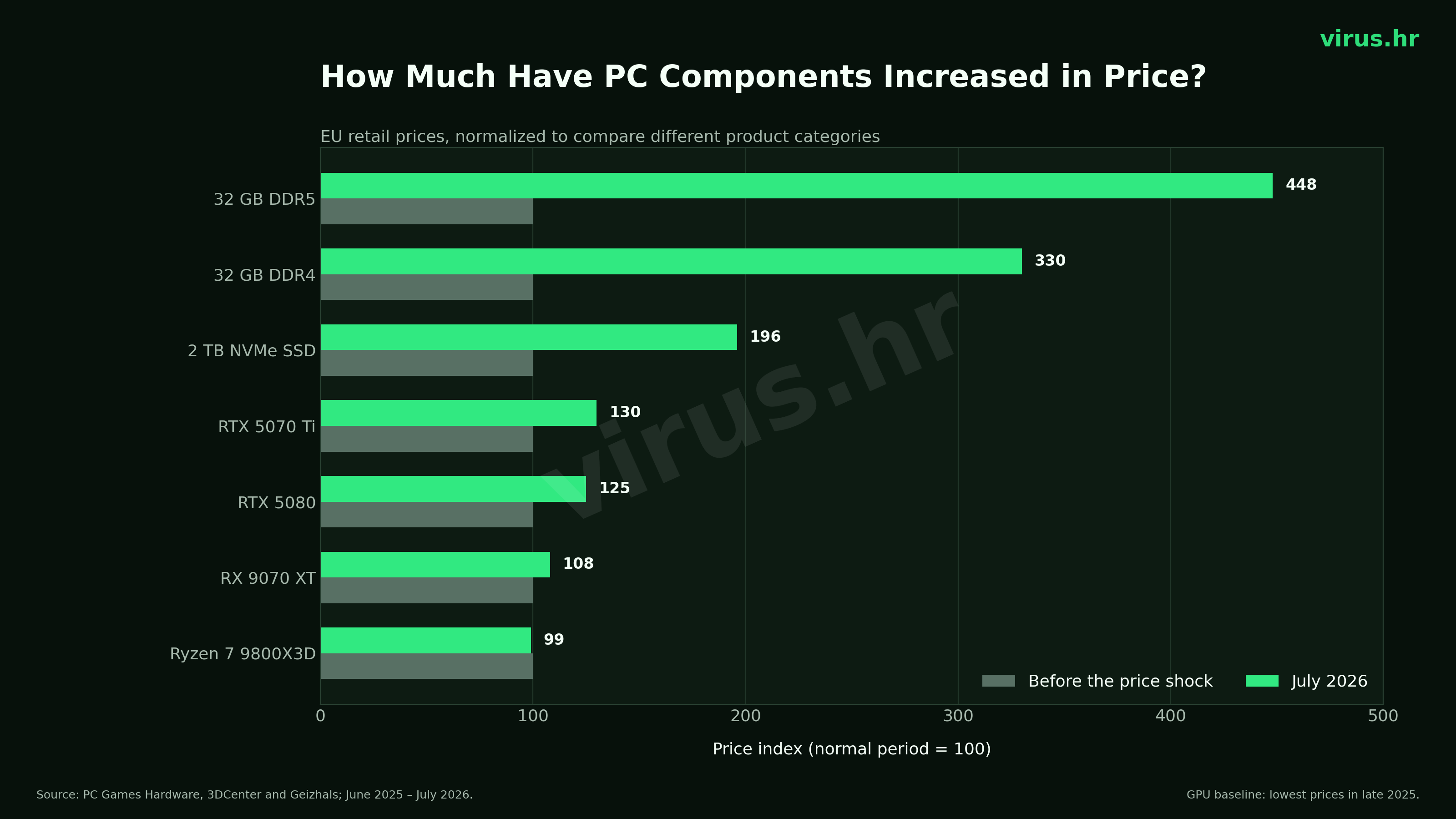
The retail price index shows how much the memory shock is greater than the price increase of GPUs. The comparison period depends on the category as current graphics cards were not equally available in June 2025. Sources: PC Games Hardware, 3DCenter, Geizhals, and TrendForce. Graphics: Virus.hr.
What does "before the AI boom" mean?
For a fair comparison, a fair starting point must be chosen. Comparing today's prices with those from 2022 would be misleading: the market was still marked by pandemic disruptions, chip shortages, and cryptocurrency mining at that time.
Therefore, we use the summer of 2025 as a baseline, just before the acute wave of memory price increases that turned AI infrastructure from an important to a dominant market factor.
This does not mean that AI did not exist before that. It means that from the second half of 2025, the ordering of HBM memory, server DRAM, and enterprise SSDs accelerated, and manufacturers began directing an increasing share of limited capacities towards higher-margin products.
Component | Reference price before the shock | Price mid-2026 | Change |
|---|---|---|---|
32 GB DDR4-3200 | around 60 € | from around 190 € | approximately 3.2 times |
32 GB DDR5-6000 | around 90 € | from around 350 € | approximately 3.9 times; broader index around 4.5 times |
2 TB PCIe 4.0 NVMe SSD | around 115 € | around 220–230 € | approximately 2 times |
GeForce RTX 5080 | around 1,000 € at the end of 2025. | around 1,180–1,250 € | approximately 18–25% |
Radeon RX 9070 XT | around €600 by the end of 2025. | around €640–680 | approximately 7–13% |
Ryzen 7 9800X3D | around €385 in June 2025. | around €380–400 | mostly unchanged |
Note: these are representative lowest prices in the large German and EU markets, not official recommended prices. Different models, latencies, coolers, controllers, vendors, and the day of measurement can change individual amounts. The GPU baseline is the end of 2025 as it pertains to the current generation of cards.
AI data centers are not buying your RAM – but they use the same factories
The most important thing to understand is that an AI data center does not go to the store for a standard DDR5 desktop RAM kit. The problem lies deeper in the supply chain: HBM for AI accelerators, server DRAM, GDDR memory for graphics chips, and regular PC RAM share part of the manufacturing infrastructure, equipment, expertise, materials, and investment budget.
When demand for an AI product is high and its margin is better, it pays off for the manufacturer to prioritize HBM and server components. The consequence is not necessarily the physical shutdown of every line for consumer RAM, but rather less available production and a weaker incentive to aggressively lower consumer prices.
TrendForce has estimated a rise in contract prices for conventional DRAM of up to 90 to 95 percent in the first quarter of 2026 compared to the previous quarter, along with a rise in NAND Flash of 55 to 60 percent. For the second quarter, estimates were an additional 58 to 63 percent for DRAM and 70 to 75 percent for NAND.
It is important to emphasize that these quarterly percentages should not simply be added to the growth of retail prices. Contract prices for chips and the final price of products do not have the same basis, nor do changes in stores appear on the same day. Nevertheless, the scale clearly shows where the problem originated.
TrendForce cites the redirection of capacity towards HBM and server DRAM as the reason for the strong growth. In the forecast for the second quarter, it also warns that NAND production is increasingly focused on enterprise SSDs.
SK hynix confirmed in its results for the first quarter that HBM, high-capacity server DRAM, and enterprise SSDs were the main drivers of record business and that customer demand exceeds available supply.
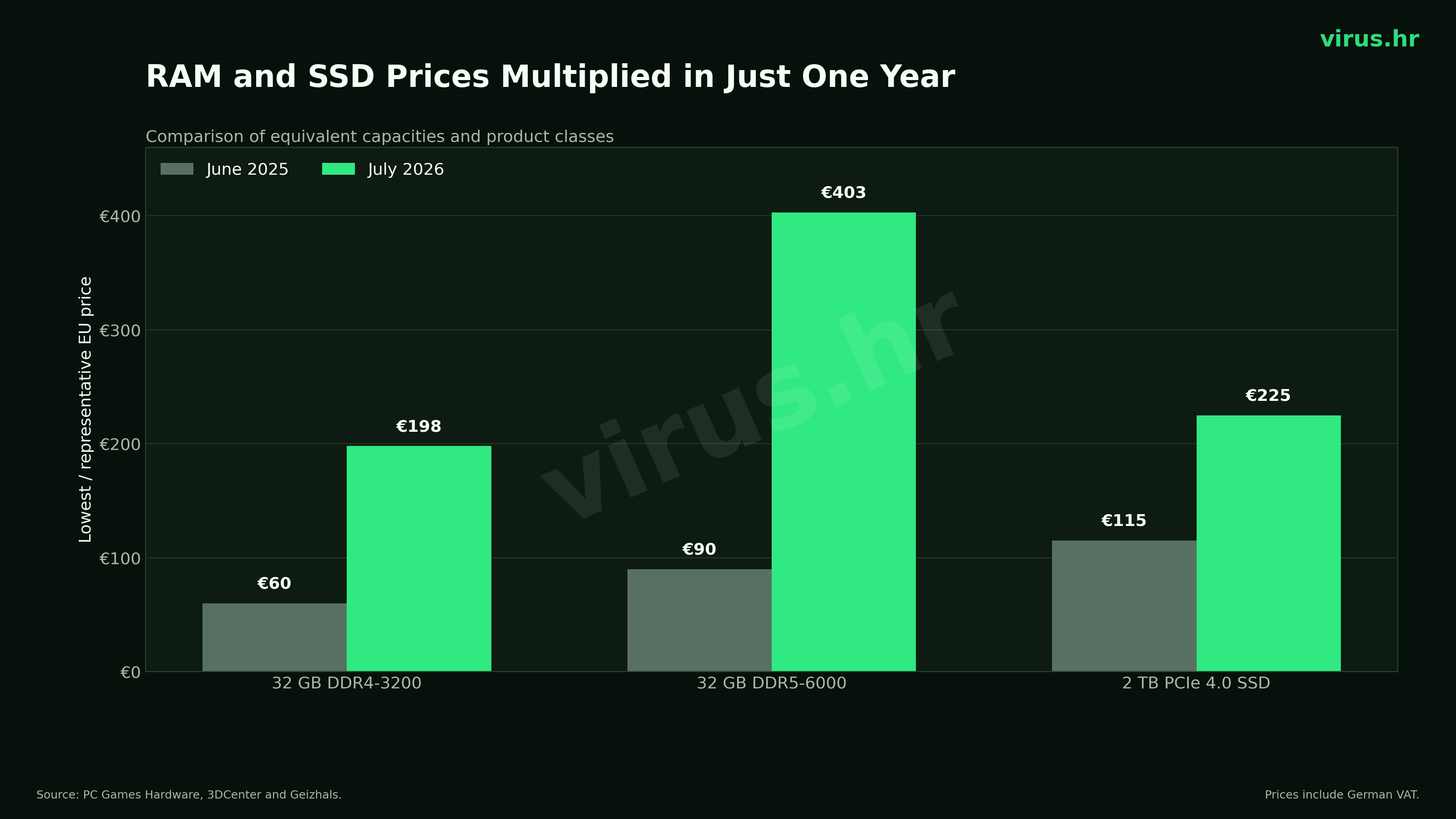
Representative EU retail prices of comparable capacities in June 2025 and July 2026. Prices include German VAT. Sources: PC Games Hardware, 3DCenter, and Geizhals. Graphics: Virus.hr.
Why don't manufacturers simply make more chips?
A memory factory cannot be expanded like a warehouse. New manufacturing plants require billions of dollars, complex lithography equipment, skilled workers, and years of preparation. Even within an existing factory, switching to a different type of memory is not instantaneous or free.
Manufacturers remember previous cycles. The memory industry is known for periods of overproduction, stockpiling, and sharp price declines. Because of this, Samsung, SK hynix, and Micron are increasing capacities more cautiously than customers would like.
They can now sell a large portion of future AI production in advance and under better conditions, so they have no strong business reason to quickly create a surplus of cheap consumer DRAM.
The extent to which market priorities have changed is best illustrated by Micron's decision in December 2025 to exit the consumer business under the Crucial brand. The company explicitly cited the growing demand from AI data centers and the need to serve larger strategic customers.
Deliveries of Crucial's consumer products ended in February 2026. This is not the only cause of the shortage, but it is almost a textbook example of shifting focus from the customer building a home computer to large infrastructure clients.
DDR4 Paradox: Older Technology is No Longer Automatically Cheaper
Customers are used to the old standard becoming cheaper over time. With DDR4 memory, the opposite has happened.
As the industry prepares for newer and more profitable products, reducing production of older chips can happen faster than the decline in demand. Millions of existing AM4 and Intel DDR4 computers still need replacement or additional modules, so lower supply raises the price of technology that is technically outdated.
Because of this, it is incorrect today to automatically assume that a “budget DDR4 configuration” will be more affordable. In certain combinations, a used platform makes sense, but new DDR4 RAM can negate much of the savings.
AMD's re-offering of processors for older AM4 systems shows that the market is still looking for ways to avoid the costly complete migration to a newer platform.
Graphics Cards Are More Expensive, But It's Not the Same Crisis
The GPU market is also feeling the AI boom. Advanced manufacturing processes, advanced packaging, and parts of the memory chain are in demand for both data centers and consumer graphics cards. Nvidia, in addition, achieves significantly greater value by selling data AI accelerators than gaming card chips.
However, actual retail data does not show a fourfold jump like DDR5 memory.
From the lowest prices at the end of 2025 to mid-2026, popular models have mostly increased in price by single digits to about thirty percent. Among representative examples, the GeForce RTX 5070 Ti and RTX 5060 Ti 16 GB have risen by about 30 percent, the RTX 5080 by approximately a quarter, while the Radeon RX 9070 and RX 9070 XT were closer to an eight percent increase.
This is uncomfortable, but the order of magnitude is completely different from the memory shock.
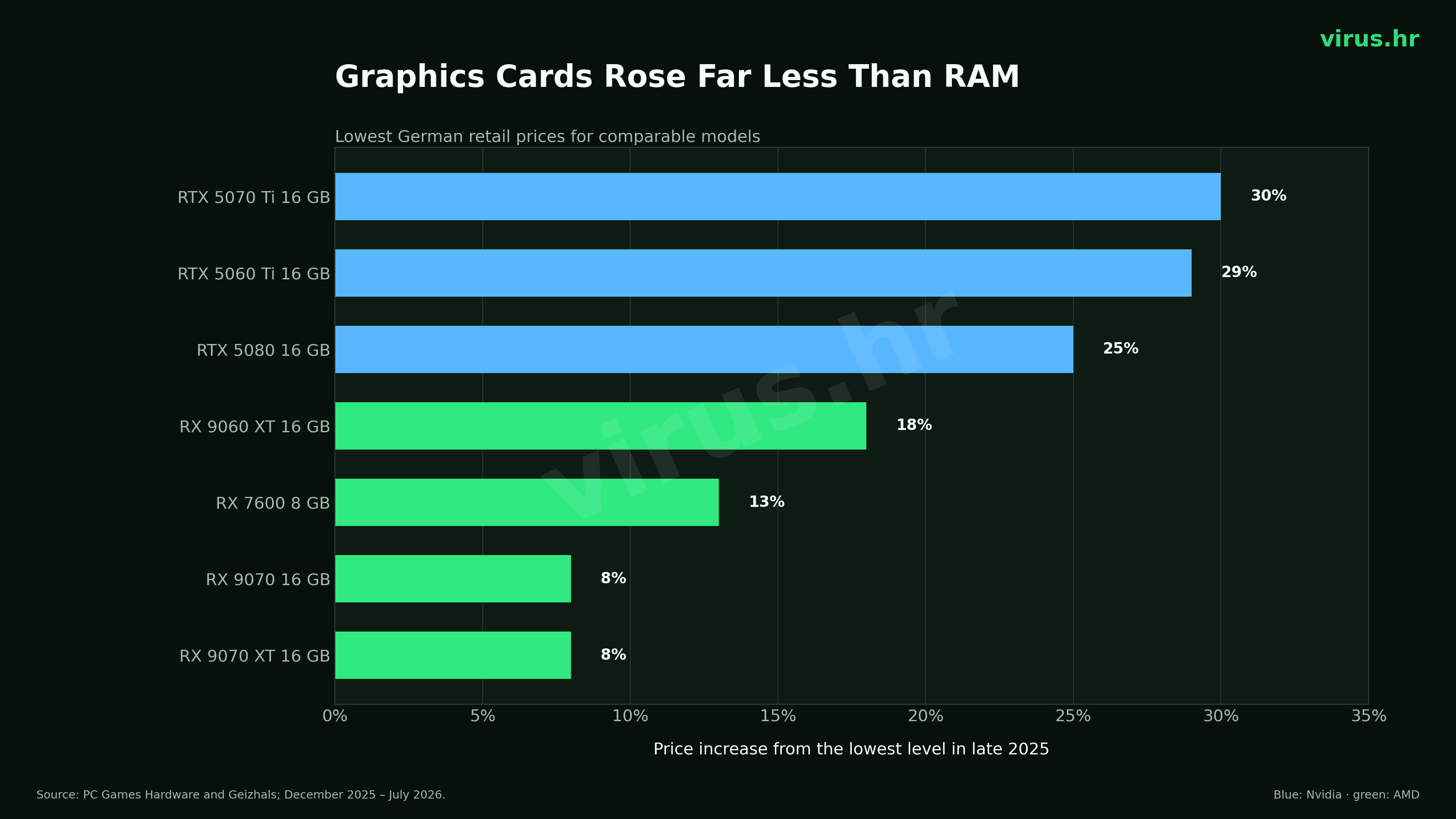
The growth of the lowest prices of comparable models from the end of 2025 to mid-2026. Blue indicates Nvidia, green AMD. Sources: PC Games Hardware and Geizhals. Graphics: Virus.hr.
Processors are a useful counterexample. The Ryzen 7 9800X3D was briefly around 385 euros in the German market in mid-2025, and in July 2026 it can still be found in approximately the same range.
Some CPU models have increased or decreased in price depending on stock and the new generation, but there is no evidence that the entire PC hardware has increased in price at the same intensity.
How much do American tariffs affect everything?
The short answer for a buyer in Croatia is: less than dramatic headlines suggest, at least for now.
The American tariff is charged upon import into the United States. A Croatian or German buyer does not pay it directly because the goods enter the European Union market according to European customs rules.
However, American trade policy can indirectly affect Europe through changes in global pricing, redirection of stocks, earlier stockpiling in the U.S., different production distribution, and additional supply chain adjustment costs.
As of July 24, 2026, the latest USTR measure stipulates that covered products from the European Union and Taiwan, if they were previously below that level, together with the regular tariff, reach a total of 10 percent, with prescribed exemptions.
Since the measure came into effect only on July 24, it cannot explain the rise in European prices of RAM and SSDs that began months earlier.
An earlier American measure under Article 232 introduced a 25 percent tariff on a narrowly defined group of advanced computer chips.
However, the same decision contains exemptions for certain purposes, including American data centers and consumer applications outside of data centers. Therefore, it is not correct to automatically claim that every gaming graphics card in the U.S. carries an additional 25 percent.
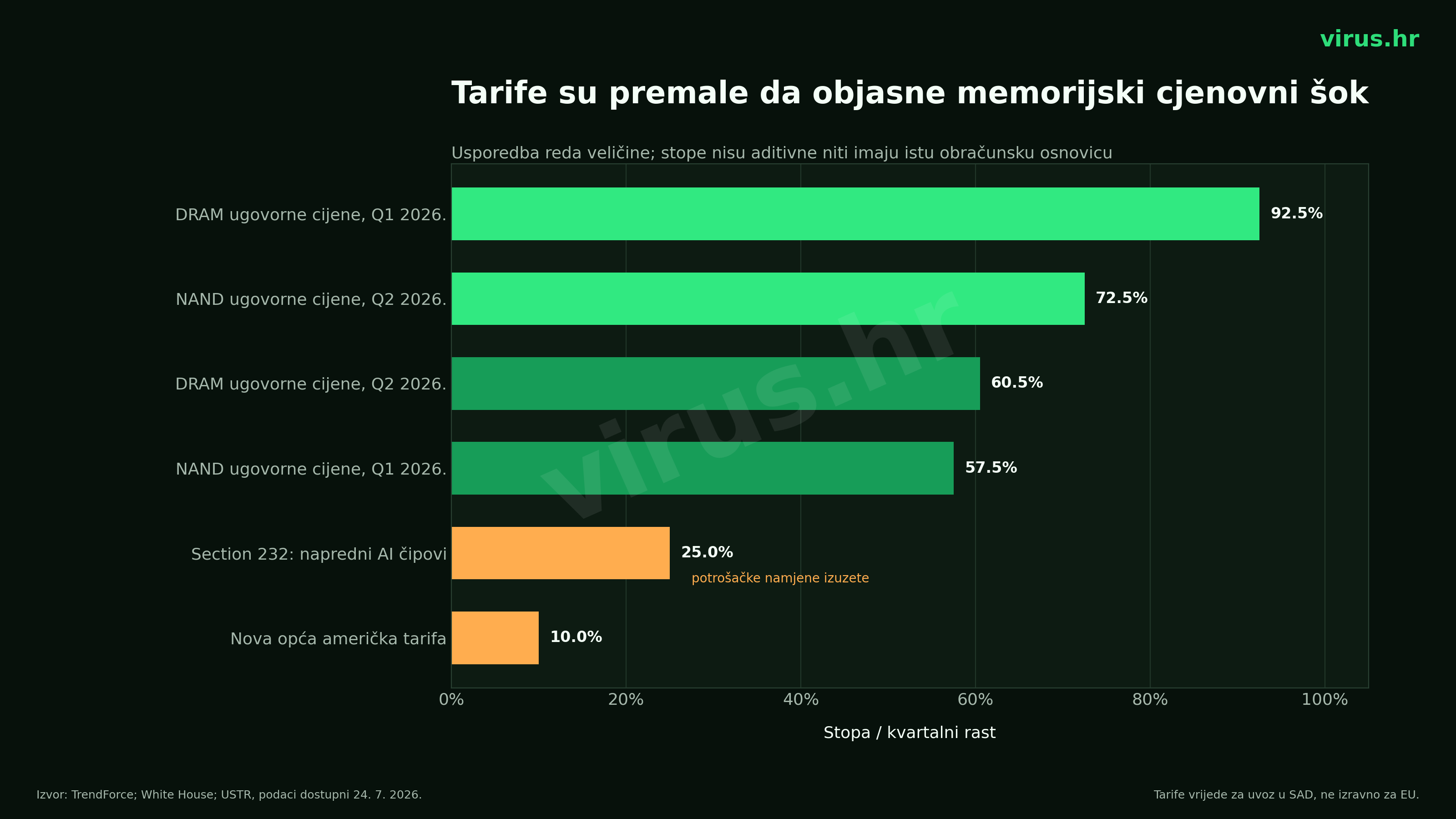
Quarterly growth of contract memory prices is several times higher than current U.S. tariff rates. The rates have different calculation bases and are not additive; the graph compares orders of magnitude, not the calculation of the final retail price. Consumer applications are exempt from the shown Section 232 measure. Sources: TrendForce, White House, and USTR. Graphics: Virus.hr.
There is no publicly measurable unique percentage of the "American tariff surcharge" for the European market. A reasonable scenario estimate, rather than an official figure, would be an indirect effect of approximately zero to three percent on RAM, zero to four percent on SSD, two to eight percent on GPU, and one to four percent on the entire computer.
The actual result may also be outside these ranges, depending on the manufacturer, exchange rate, and stock distribution.
It is important to compare orders of magnitude. A tariff of 10 or even 25 percent cannot alone explain the increase in RAM prices from 200 to 350 percent. The timing also does not match: memory prices surged significantly before the latest U.S. measures.
Therefore, tariffs are a secondary pressure and risk for future prices, not the main cause of the current European crisis.
Why is it often even more expensive in Croatia?
Prices in Croatia are further shaped by a VAT of 25 percent, a smaller market, a narrower selection of retailers, slower inventory turnover, and distribution costs.
The German VAT is 19 percent, so an identical product with the same net price would have about five percent higher final price in Croatia just due to taxes. A difference greater than that can come from the purchase price, margin, volume discount, and age of inventory.
However, this still does not explain the multiple price increases in memory. VAT has not suddenly tripled.
Local factors determine how much the Croatian price will deviate from large EU retailers, while the main shock occurred earlier, on a global level of chips and contract prices.
When could prices fall?
A quick return to prices from the summer of 2025 does not seem likely for now. TrendForce still expects growth in conventional DRAM of 13 to 18 percent and NAND of 10 to 15 percent in the third quarter of 2026 compared to the previous quarter.
The growth rate is slowing, but prices are not yet falling.
For NAND, there is somewhat better long-term news. In a July analysis, TrendForce estimates that the market will be short by four to five percent in 2026 and that supply tension could start to ease in the second half of 2027.
Server systems already account for more than 40 percent of NAND demand, which explains why consumer SSDs are no longer the only significant volume.
The outlook for DRAM is more cautious. New production is arriving slowly, and HBM and server memory remain a priority. Even if contract prices stop rising, it takes time for cheaper chips to pass through module manufacturers, distributors, and retail inventories.
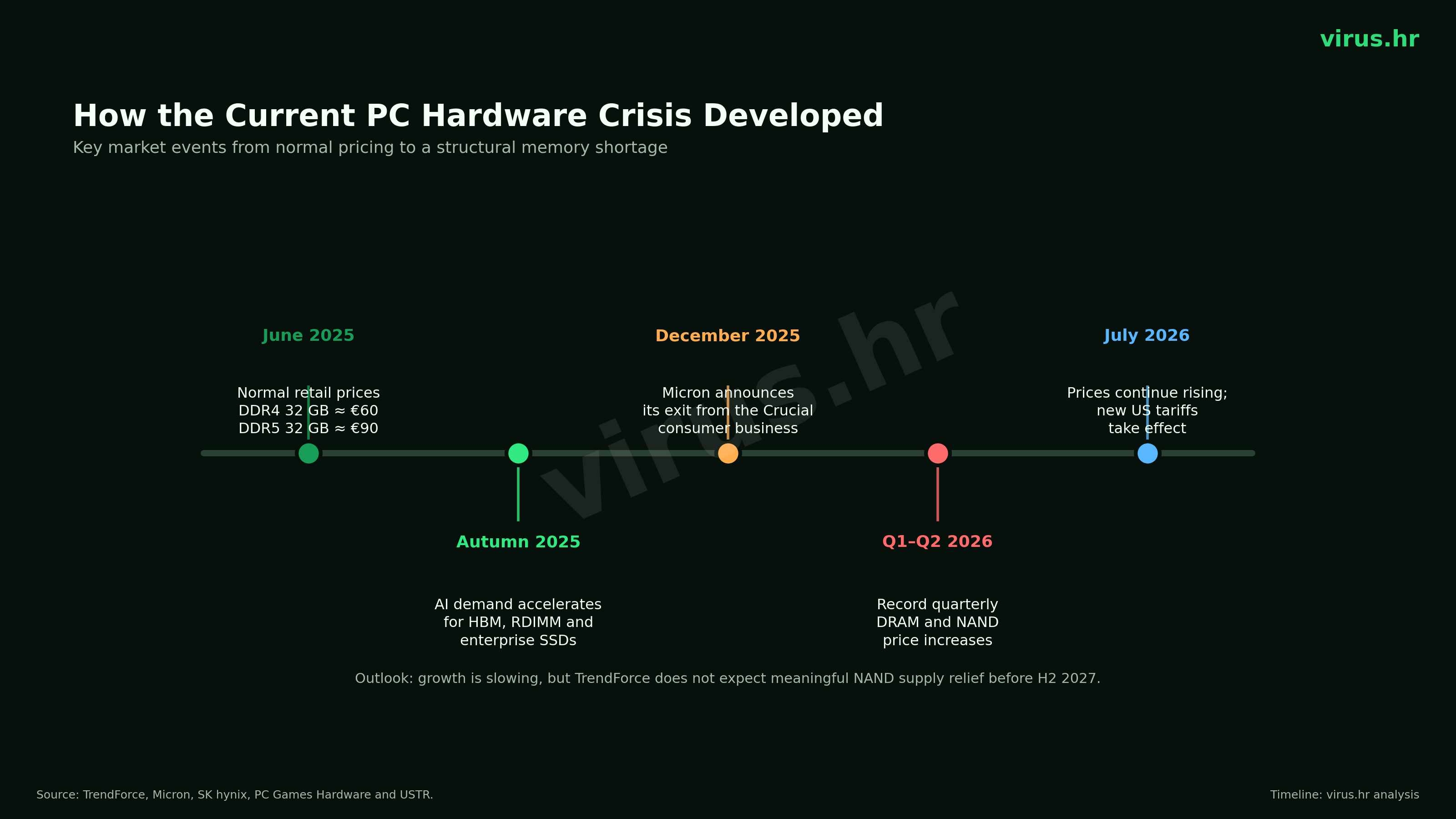
From normal retail prices in June 2025 to record growth in contract prices in early 2026. The latest U.S. tariffs arrive only after the bulk of the price increases. Sources: TrendForce, Micron, SK hynix, PC Games Hardware, and USTR. Graphic: Virus.hr.
What makes sense to buy now?
If your computer still meets your needs, upgrading RAM and SSD should not be done out of panic. The most expensive decision can be buying capacity that you do not need just because you expect even greater increases.
First, check the actual memory and space usage, supported modules, and available slots.
For a new computer, the price should be viewed as a whole. A cheaper processor or motherboard can free up the budget for overpriced memory. For gaming, it is often more reasonable to keep the existing SSD and RAM if they are compatible, and direct a larger part of the budget towards the graphics card.
A used DDR4 kit can be more rational than a new one, provided it can be tested and the seller provides clear information about the model.
The purchase of a GPU should be assessed based on the specific model, not on a general narrative. AMD models during the observed period generally experienced a milder increase compared to certain Nvidia cards, but the crucial factors are the price at the time of purchase, power consumption, ray tracing, software capabilities, and the amount of VRAM.
There are still good deals on processors because their pricing cycle is not the same as that of memory.
Conclusion: prices have risen, but not all culprits are equal
PC components have indeed become more expensive, but the headline “AI and tariffs have raised all prices” hides the most important differences.
The biggest problem is memory. The explosion of investment in AI data centers has increased the demand for HBM, server DRAM, and enterprise SSDs, and manufacturers have shifted limited capacities towards those products. Consumer RAM and SSDs have therefore been left with lower supply and significantly higher prices.
Graphics cards are feeling the same ecosystem of constraints, but they have become more expensive to a far lesser extent during the comparable period. Processors show that this is not a universal increase for all components.
American tariffs can add pressure, especially through global pricing and distribution of supplies, but they are not directly charged to the Croatian consumer and cannot explain either the magnitude or timing of the European memory shock.
The fairest summary is: AI is the main structural cause, disciplined and concentrated memory supply has amplified the impact, and tariffs are so far a secondary – though worth monitoring – factor.

-hero.webp)




-hero.webp)

-hero.webp)























-hero.webp)
-hero.webp)